Why Reverse Engineer Turbine Parts?
Many Indian industrial plants operate turbines that are 20–40 years old. Original equipment manufacturers have discontinued certain models, merged with other companies, or simply stopped stocking spares for older machines. Lead times from overseas OEMs for machined components routinely exceed 12–18 months — unacceptable when a sugar mill has a fixed crushing season or a power plant has a contract penalty for each day offline.
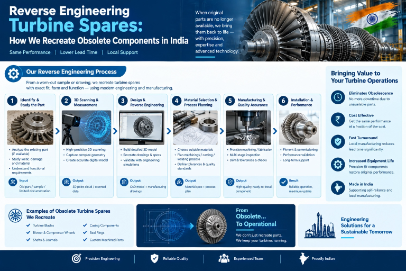
Step 1: Component Acquisition & Initial Assessment
We start with the worn or broken component itself — or the mating part if the original is beyond measurement. The component is cleaned and visually assessed to determine which surfaces are still measurable and which have been degraded by wear or damage.
Step 2: 3D Laser Scanning & CMM Measurement
For complex profiles — rotor blades, nozzle blocks, diaphragms, governor components — we use a 3D laser scanner to capture the complete geometry as a point cloud. For simpler rotationally-symmetric parts — journal bearing housings, labyrinth ring grooves, seal rings — a coordinate measuring machine (CMM) captures critical dimensions with micron-level accuracy.
- All critical dimensions recorded with tolerances
- Concentricity and parallelism of mating faces checked
- Thread forms, keyway depths, and interference fits measured
- Surface finish specifications noted where measurable
Step 3: PMI Material Testing
Positive Material Identification (PMI) using portable X-ray fluorescence (XRF) or optical emission spectrometry identifies the exact alloy composition of the original component. This is critical — a rotor shaft in 12% Cr steel behaves very differently from a 1% Cr-Mo shaft. Getting the material wrong means the reverse-engineered part will fail prematurely.
Step 4: Engineering Drawing Generation
From the scan data, CMM measurements, and material test results, our engineers generate a complete manufacturing drawing. This includes all dimensions with tolerances, surface finish specifications, pre- and post-heat treatment procedures, material specification, and inspection requirements.
Step 5: Machining & Quality Control
Machining is performed in three stages: rough machining to near-final dimensions, heat treatment if required (stress relieving, quench and temper, nitriding), and final precision machining. Each stage is inspected against the engineering drawing. Rotors are dynamically balanced to ISO 1940 / API 670 standards before dispatch.
Turbines We Cover
We have reverse-engineered components for steam turbines from 5 kW to 60 MW across all major makes: Triveni, Siemens, BHEL, Belliss & Morcom, Maxwatt, Man Turbo, Chola Turbo, DLF-Skoda, KKK, and ABB. Both back-pressure and condensing turbines, horizontal and vertical, single and multi-stage.
Have an obsolete spare you need reverse-engineered? Send us a photo and your turbine details on WhatsApp — we will assess feasibility within 24 hours.
WhatsApp Us