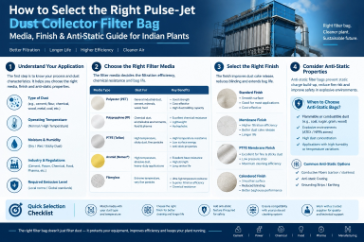
Pulse-jet baghouses are the workhorses of industrial dust control across India — cement plants, coal handling systems, grain mills, pharmaceutical powder processing, and chemical plants all depend on them to meet emission norms and protect workers. Yet replacement filter bag selection is still often done by habit ("same as before") rather than engineering. When the "same as before" bag was wrong for the application, the new set fails just as fast as the last one.
Step 1 — Know Your Flue Gas Temperature
Temperature is the most critical selection parameter and the most common cause of premature bag failure. Every media type has a continuous service temperature limit and a peak (surge) temperature limit. Exceeding the continuous limit by even 10–15°C cuts filter life by 50% or more through hydrolysis (in humid flue gas) or oxidation (in dry, oxygen-containing gas).
- Polyester needle felt: continuous 130°C, peak 150°C — general industrial dust, ambient to low-temperature applications
- Polypropylene felt: continuous 90°C, peak 110°C — acid gas environments, chemical plants (better acid resistance than polyester, lower temperature)
- Aramid / Nomex: continuous 200°C, peak 220°C — kiln exhaust, asphalt plants, glass furnace, dryer outlet
- PPS (Ryton): continuous 190°C, peak 210°C — acid + heat combination (sulphur-bearing flue gas from coal combustion)
- Glass fibre woven: continuous 260°C, peak 280°C — cement kiln raw meal, waste incineration, high-temperature process gas
- PTFE membrane on any base: same temp rating as base media + near-zero residual dust cake — highest cleaning efficiency
Step 2 — Smooth Bag or Pleated Cartridge?
Standard pulse-jet baghouses use cylindrical filter bags — smooth outer surface — supported on a metal cage. This is the correct choice for high dust-loading applications: cement, fly ash, coal, mineral processing. The smooth outer surface allows the pulse-jet compressed air shock to eject the dust cake efficiently. Pleated cartridge elements — accordion-pleated media around a perforated core — provide up to 5× the filtration area in the same housing footprint, but are better suited to lighter dust loads in pharmaceutical, food, and light chemical applications where the higher media area enables lower face velocity and very low residual pressure drop.
Step 3 — Surface Treatment: Plain, Singed, Glazed, or PTFE Membrane?
The outer surface treatment of a needle-felt bag determines how well the dust cake releases during pulse-jet cleaning and how long the bag resists blinding (permanent clogging). Plain felt has a rough fibre surface — adequate for coarse, dry, non-sticky dust. Singed felt has the surface fibres thermally removed, producing a smoother surface — improved cake release for most industrial dust. Calendered (glazed) felt is hot-pressed to further smooth and densify the surface — best for fine, cohesive, or slightly sticky dust such as pharmaceutical powders or fine cement. PTFE membrane laminated to the outer surface — the premium option — provides surface-loading filtration. Dust forms a thin cake on the smooth PTFE and releases completely with each pulse, maintaining near-initial pressure drop throughout the bag life. Emission performance is also superior, often achieving outlet dust concentrations of 2–5 mg/Nm³ vs 20–50 mg/Nm³ for plain felt.
Step 4 — Anti-Static and Conductive Bags for Explosive Dust
For dust collector applications handling electrically resistive dust that can accumulate static charge — coal, grain, flour, pharmaceutical powders, polymer powder — standard polyester bags are a fire and explosion hazard. The dust cake on a plain polyester bag can develop a static discharge (spark) energetic enough to ignite a dust cloud in the outlet plenum. Anti-static bags use one of two approaches: (1) carbon fibre blended into the polyester media — the conductive fibres dissipate charge continuously; (2) stainless steel fibre woven into the needlefelt at 1–3% by weight — provides both static dissipation and improved strength. Always specify anti-static (conductive) bags for coal dust, grain dust, flour, and any powder with a Kst value above zero.
Matching Bag Dimensions to Your Cage
Replacement filter bags must match the existing cage diameter and length exactly — even 5 mm diameter difference prevents proper sealing at the top snap ring. Before ordering, measure: outer diameter of the bag mouth (snap band OD), bag length from snap ring face to closed bottom, and the end cap type (snap ring, snap band, or flange). If the original OEM bag label is still readable, note the part number — this identifies the exact cage geometry. If labels are gone, pull one cage from the housing, measure it, and supply these dimensions with your order.
We supply pulse-jet filter bags in polyester, aramid, PPS, glass fibre, and PTFE membrane grades, along with pleated cartridge elements, for cement, power, pharmaceutical, and grain handling baghouses across India. Send us your bag dimensions and application details on WhatsApp for a same-day quotation.
WhatsApp Us