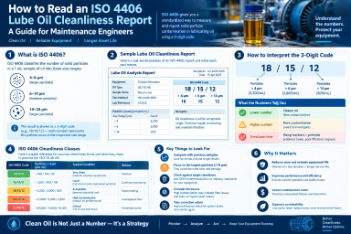
Every month, thousands of oil analysis reports land in plant maintenance offices across India — and most of them are filed without being understood. ISO 4406 cleanliness codes are the single most actionable number in that report. Getting them wrong costs bearings. Getting them right extends turbine life.
What Does an ISO 4406 Code Mean?
An ISO 4406:99 cleanliness code has three numbers, for example 18/16/13. Each number is a "range code" representing a particle count per millilitre of oil at three different particle sizes: 4 µm(c), 6 µm(c), and 14 µm(c). The "(c)" suffix means the count uses the optical particle counter calibration per ISO 11171 — do not compare with older reports that used the uncalibrated method.
- Range code 14 = 80–160 particles/mL
- Range code 16 = 320–640 particles/mL
- Range code 18 = 1,280–2,560 particles/mL
- Range code 20 = 5,120–10,240 particles/mL
- Each step up = doubling of contamination level
What Cleanliness Target Do You Need?
For steam turbine journal bearing and lube oil systems, the target is typically ISO 4406:99 Class 16/14/11 — this is the minimum requirement in API 614. Many OEMs including Triveni and Siemens specify 15/13/10 for turbines with hydraulic control systems. After a major overhaul or lube oil flush, the system should achieve 16/14/11 before oil-in to prevent bearing contamination damage during run-up.
When Should You Act?
If your routine oil analysis report shows the 6 µm(c) range code (middle number) at 17 or higher — one step above target — investigate immediately. Check filter differential pressure (replace if approaching 3.5–4 bar), inspect tank breather condition, and sample the inlet and outlet of the filter housing separately to locate where contamination is entering. If the water content report shows more than 0.1% water — replace the filter elements and schedule an offline WaterSorp filtration run.
The Cost of Ignoring a Deteriorating Code
Particles in the 4–10 µm range are the most damaging — they are exactly the right size to enter the hydrodynamic oil film between a rotating journal and Babbitt bearing surface and cause three-body abrasion. A turbine running with ISO cleanliness code 20/18/15 instead of 16/14/11 has approximately 100× more damaging particles than target. Bearing surfaces degrade progressively and the failure is gradual until it is not — then it is a 48-hour emergency and a Babbitt re-pour.
We supply ISO 16889-compliant filter elements for all major turbine makes and can advise on lube oil flushing to achieve the correct cleanliness class before your next startup. Contact us on WhatsApp.
WhatsApp Us