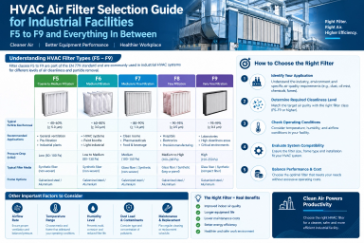
Walk into any industrial plant in India — a sugar mill, a pharmaceutical factory, a cement control room — and you will find HVAC air handling units (AHUs) quietly keeping people and sensitive equipment alive. Walk a little further and you will often find those AHUs running with the wrong filter grade, a clogged-out bag that was last replaced two years ago, or no pre-filter at all. The results are predictable: DCS cabinets full of dust, cooling coils coated in grey felt, and electricity bills 15–20% higher than they need to be.
Understanding Efficiency Classes — EN 779 and ISO 16890
Two standards govern HVAC filter efficiency. The older EN 779 uses grades G1 through F9 — G (coarse) grades capture large particles, M (medium) and F (fine) grades capture progressively smaller ones. The newer ISO 16890 uses particle size-based classifications: ePM10, ePM2.5, and ePM1, with a percentage capture efficiency. If your filter supplier quotes only an EN 779 grade, ask for the ISO 16890 ePM1 efficiency — it is the more meaningful number for air quality.
- G1–G4 (ISO Coarse): Captures lint, fibres, insects, large dust — used as pre-filters and in metallic mesh washable panels
- M5–M6 (ISO ePM10 ≥50%): Pollen, coarse dust, sand — suitable for non-critical industrial ventilation
- F7 (ISO ePM1 ≥50%): General HVAC standard — the minimum for occupied offices, control rooms, and AHUs feeding sensitive equipment
- F8 (ISO ePM1 ≥70%): Hospital ward supply, pharmaceutical Grade D preparation areas
- F9 (ISO ePM1 ≥85%): Pre-filter upstream of HEPA for cleanrooms and critical pharmaceutical areas
Step 1 — Start with a Metallic Mesh Pre-Filter (G1–G3)
Every AHU in a heavy industrial environment — cement plant, power station, steel mill — should have a washable aluminium or SS mesh pre-filter at the first stage. Cost: a few hundred rupees. Benefit: the downstream bag or pleated filter lasts 2–3× longer because it never has to handle the coarse load. Aluminium mesh handles temperatures up to 150°C; SS mesh up to 350°C. Clean with compressed air blowback or warm water every 4–6 weeks.
Step 2 — Choose Your Main Filter: Pocket Bag or Pleated Panel?
Both pocket bag filters and pleated panel filters are available from G4 to F9, but they suit different AHU configurations. Pocket bag filters (multi-pocket) have a larger media area and longer service life in high-dust environments — the pockets extend into the airstream, maximising contact area. They are the standard choice for large industrial AHUs, commercial buildings, and hospitals. Pleated panel filters are more compact (25–96 mm deep vs 600 mm pocket length) and rigid, making them the preferred choice for fan coil units (FCUs), split-AC units, and vertical-airflow AHUs where space is limited.
- Pocket bag filter: high dust load, large AHU, F5–F9, 3,000–5,000 m³/h+ per section
- Pleated panel (25 mm): FCU/split AC replacement, G4–F7, compact vertical airflow
- Pleated panel (96 mm): Mid-size AHU, F7–F8, rigid construction — no pocket collapse risk
- Pleated panel (292 mm extended): Final-stage high-efficiency in pharmaceutical HVAC, F8–F9
Step 3 — Add Activated Carbon for Odour Control
If your facility has odour problems — kitchens, chemical storage, painting shops, printing presses, or any area with VOC emissions — a particulate filter alone will not solve the problem. Activated carbon (GAC) adsorbs cooking odours, solvents, hydrogen sulphide, formaldehyde, and most common industrial VOCs. In HVAC applications, activated carbon is typically supplied as a panel filter with a 25–50 mm granular carbon bed, or as a combination filter with a G4 particulate pre-filter bonded to the carbon layer. The carbon panel goes after the particulate filter in the air stream — putting it first wastes expensive carbon capacity on dust loading.
How to Size Filter Replacement Intervals
The single best practice is to install a differential pressure (DP) gauge across each filter stage and replace at 250 Pa final pressure drop — not on a calendar schedule. Calendar replacement wastes serviceable filters; run-to-failure causes the filter to collapse or bypass, contaminating the AHU coil with everything it was supposed to capture. If DP gauges are not practical, replace every 3 months in heavy industrial environments (cement, power, steel), every 6 months in light industrial, and annually in clean commercial environments — adjusting based on visual inspection.
We supply HVAC pocket bag filters, pleated panel filters, metallic mesh pre-filters, and activated carbon vent filters for industrial and commercial AHUs across India. Contact us on WhatsApp with your AHU make, model, and frame dimensions for a matched replacement quotation.
WhatsApp Us