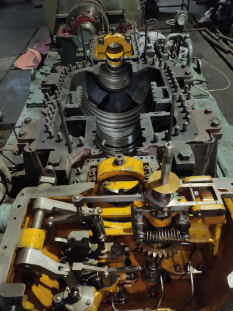
Belliss & Morcom (now Howden) turbines are found in hundreds of Indian sugar mills, co-generation plants, and industrial facilities. Our engineers have worked on Belliss units for over 20 years across UP, Punjab, Maharashtra, and Karnataka. Here are the faults we encounter most frequently — and the correct way to diagnose and resolve each one.
Fault 1: High Vibration at Operating Speed
The most common complaint on Belliss turbines is elevated vibration, typically detected by operators as increased noise and confirmed by portable vibration analysis. The leading root causes, in order of frequency, are: (1) rotor imbalance from deposit build-up on blades, (2) journal bearing wear — especially after long runs between overhauls, and (3) misalignment between the turbine and gearbox due to pipe strain or foundation settling.
- Check bearing temperatures first — elevated temperature alongside high vibration almost always indicates bearing condition issues
- Take a portable vibration reading at all four bearing housings and compare to baseline (1× and 2× running speed)
- If 1× dominant: imbalance or misalignment. If 2× dominant: bearing looseness or misalignment. Sub-synchronous: oil whirl
- Inspect the coupling for wear and correct assembly before concluding misalignment is a turbine problem
Fault 2: Governor Hunting / Speed Instability
Belliss turbines use a centrifugal fly-ball governor or hydraulic governor depending on the model and vintage. Speed hunting — cyclic overshoot above and below setpoint — is typically caused by: worn pivot pins and fly-balls in centrifugal governors, incorrect droop setting, control valve actuator hysteresis, or steam pressure fluctuations from the boiler exceeding the governor authority.
Before dismantling the governor, confirm the steam supply pressure is stable. If supply pressure is fluctuating more than ±0.5 bar, the boiler control loop is the primary problem — the governor cannot compensate for large supply swings. Once boiler stability is confirmed, the governor pivot pins and fly-ball weights should be inspected for wear and replaced if clearances are excessive.
Fault 3: Steam Gland Leakage
Belliss turbines use labyrinth gland seals and gland steam systems to control leakage at the shaft ends. Visible steam leakage at the gland area in normal operation indicates: worn or damaged labyrinth strips, incorrect gland steam pressure setting, or shaft eccentricity causing uneven clearance around the labyrinth.
- Measure shaft eccentricity at the gland area using a dial gauge — if runout exceeds 0.05 mm, the rotor condition must be assessed
- Check gland steam pressure versus saturation conditions — condensing water in the gland steam supply line causes severe labyrinth erosion
- Labyrinth strip replacement is a planned outage item — do not attempt to reduce clearances by shimming strips in situ
Fault 4: Lube Oil High Temperature or Low Pressure
Lube oil system faults on Belliss turbines account for more unplanned trips than any other cause. High oil temperature (above 55°C at bearing inlet) typically means the lube oil cooler is fouled — clean the cooler shell and tube bundle. Low oil pressure trips occur when the relief valve is set incorrectly, filter differential pressure is high (element needs replacement), or the oil pump is worn and losing volumetric efficiency.
Need our ex-Belliss & Morcom engineers for an overhaul, vibration analysis, or emergency fault diagnosis? Contact us on WhatsApp for a same-day response.
WhatsApp Us